Can you keep your skin fade after a hair transplant?
If a skin fade is your usual haircut, the donor area matters alongside the new hairline. Discuss it before booking: you may be pleased with growth at the front and disappointed by how the back and sides look when cut short.

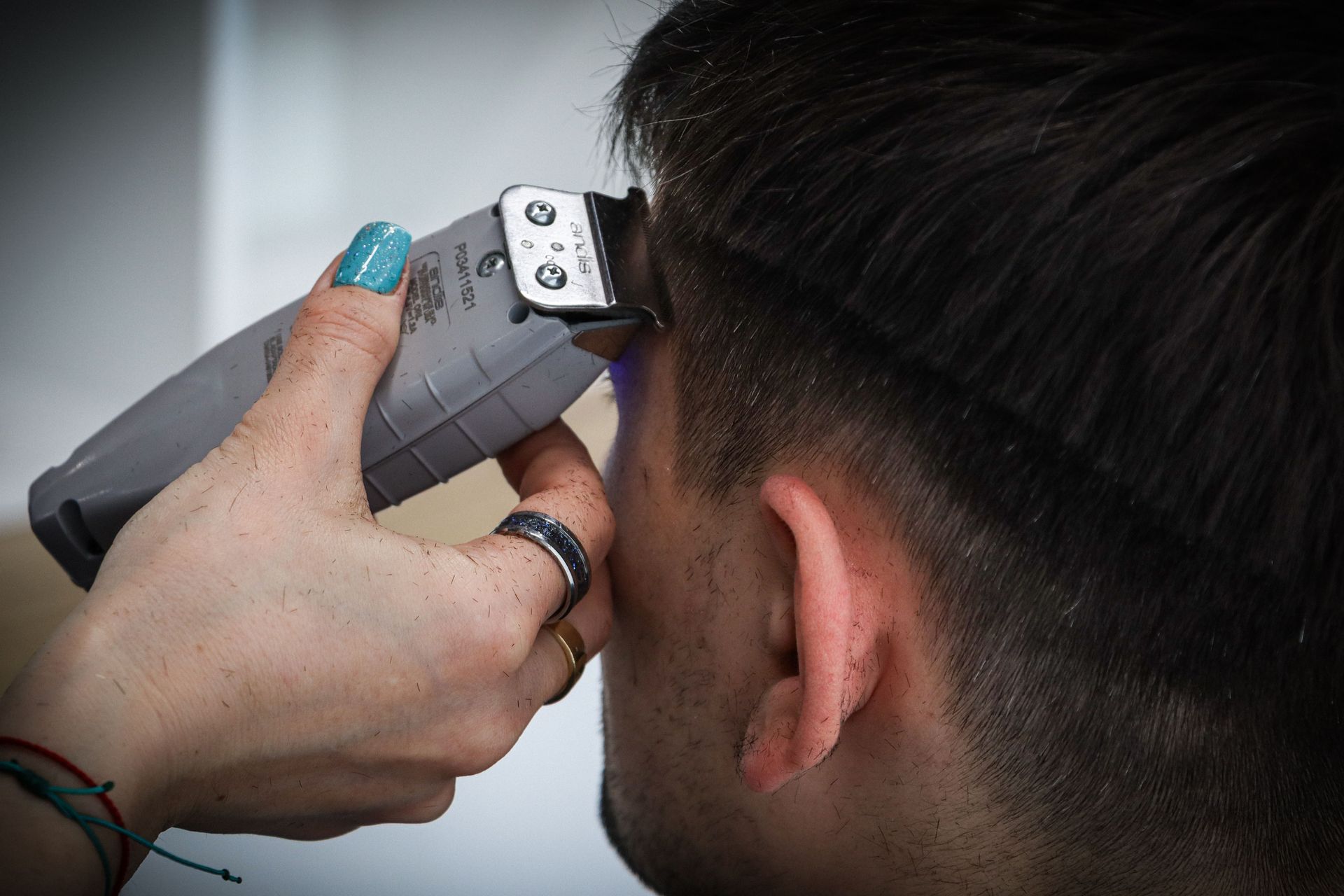
A close haircut may be possible after recovery. There is no promise that every patient can shave down to the skin without visible signs of surgery, though. Ask what the proposed procedure would mean for your usual haircut.
FUE and FUT leave different scars
| Technique | What a close haircut may reveal |
|---|---|
| FUE | Small scars where individual follicular units were removed through circular incisions. There is no continuous strip-surgery line. |
| FUT | A linear donor scar where a strip of hair-bearing scalp was removed. A very short cut may reveal the line. |
FUE scar visibility varies with healing, the size and number of extractions, and how much surrounding hair covers them.
The International Society of Hair Restoration Surgery explains why FUE is not scarless. This matters particularly when discussing a skin fade: a photograph with several centimetres of hair does not show how the same donor area would look shaved close.
Because the scars are distributed differently, FUE and FUT have different implications for haircut planning.
Read our guides to FUE hair transplantation and FUT hair transplantation before discussing the options. Suitability also depends on your hair loss, donor supply, medical history and longer-term goals.
Can the surgeon promise a zero fade?
A promise such as “you can always wear a zero” is too simple. Hair thickness, curl and contrast with the scalp affect how dense the donor area looks. Existing scars and previous harvesting also need assessment.
The ISHRS guide to FUE highlights both hair characteristics and the risk of taking too much from the donor region. Extracted follicles are being moved elsewhere; they are not an unlimited resource. Planning should consider the appearance of the donor area as well as coverage on top.
Bring photographs of your normal haircut, including the back and both sides. Tell the surgeon where the fade starts, how close the barber cuts it and whether keeping that style is essential to you. Ask whether leaving more length would make a noticeable difference.
Your first haircut after surgery
Ask your treating clinic for clearance before using clippers or a razor over operated skin. The donor and recipient areas may need different precautions, and a general internet timetable cannot account for how your own scalp is healing.
Request written instructions for washing, haircuts and styling products. Share the haircut instructions with your barber and explain which areas were treated. If the scalp remains sore or irritated, contact the clinic before proceeding with a close cut.
Our aftercare guide and recovery timeline explain the wider recovery process. The appearance shortly after surgery is not the final result.
The photographs to ask for
Before-and-after photographs are more useful when they answer your actual concern. Ask to see healed donor areas as well as the new hairline, and ask what length the hair is in each photograph.
Compare photographs taken in similar lighting and from similar angles. Ask for close-ups: a distant view from the front cannot show the same donor-area detail. Examples help you understand the surgeon’s work, but another patient’s result cannot guarantee your own.
Make your haircut part of the treatment plan
Your consultation should cover likely scarring, the proposed extraction area, what will remain in reserve and the limits of treatment. Ask who performs the surgery and who you would contact if recovery does not go as expected.
If wearing a skin fade without visible marks is a non-negotiable requirement, say that plainly. It may change the treatment plan or your decision about whether surgery is right for you.
To discuss your hair loss and usual haircut, contact Belfast Hair Transplant or call 028 9600 0113. You can also read about Dr Harpreet Kalra before your appointment.
Dr Harpreet Kalra
Belfast Hair Transplant